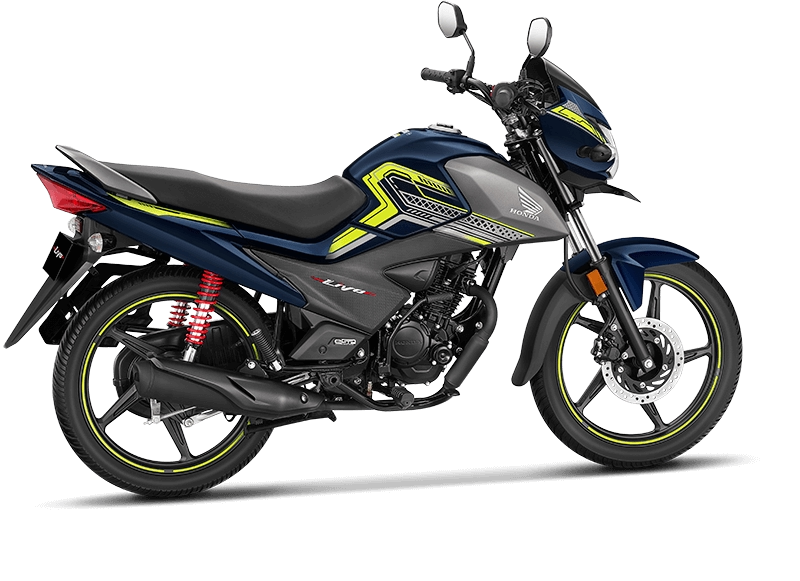
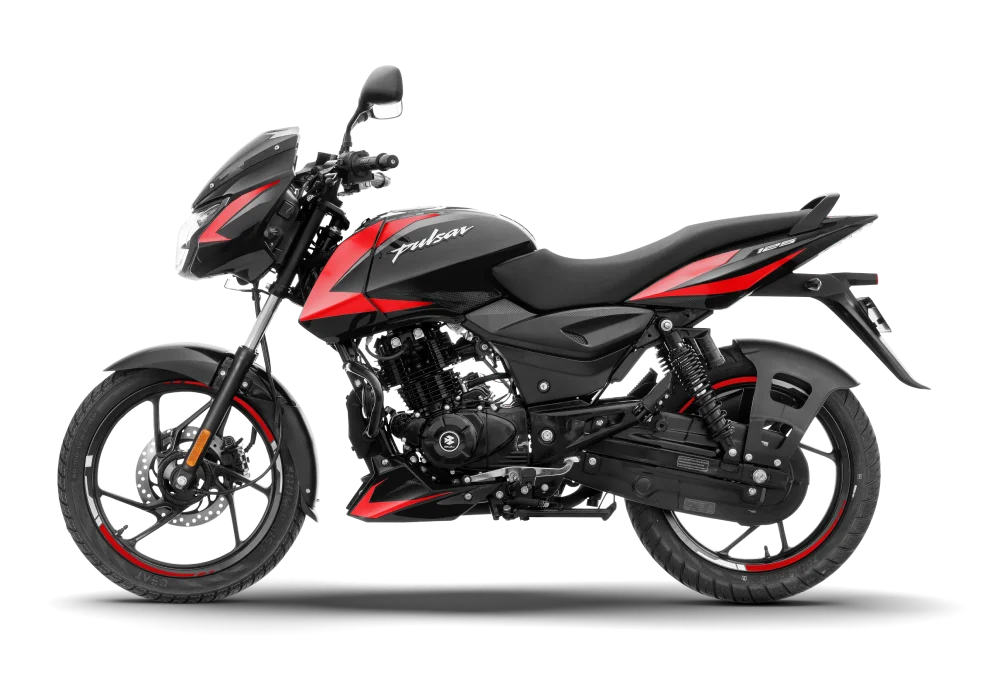
At a Glance
Key differences that define each motorcycle
Honda Livo
- 109.51 cc Air-Cooled
- 8.79 PS @ 7500 rpm
- 70 km/l (ARAI)
- 9-litre tank
- 2 variants available
- CBS braking (both variants)
Bajaj Pulsar 125
- 124.38 cc Air-Cooled
- 11.8 PS @ 8500 rpm
- 57 km/l (ARAI)
- 15-litre tank
- 3 variants available
- CBS with front disc (all variants)
Full Specification Comparison
Every number that matters — side by side
| Specification | Honda Livo | Bajaj Pulsar 125 |
|---|---|---|
| Engine & Performance | ||
| Displacement | 109.51 cc | 124.38 cc |
| Cooling System | Air Cooled | Air Cooled |
| Max Power | 8.79 PS @ 7500 rpm | 11.8 PS @ 8500 rpm |
| Max Torque | 9.30 Nm @ 5500 rpm | 10.8 Nm @ 6500 rpm |
| Valves per Cylinder | 2 | 2 |
| Spark Plugs | 1 per cylinder | 2 per cylinder (Twin Spark) |
| Compression Ratio | 10.0 : 1 | 10.05 ± 0.3 : 1 |
| Bore × Stroke | 47.0 × 63.1 mm | 52 × 58.6 mm |
| Emission Standard | BS6 Phase 2 (OBD2) | BS6 Phase 2 |
| Transmission | 4-Speed Manual | 5-Speed Manual |
| Top Speed | 90 km/h | ~100 km/h |
| Start Type | Electric & Kick Start | Electric Start |
| Fuel & Range | ||
| Mileage (ARAI) | 70 km/l | 57 km/l |
| Mileage (Real-world) | 60–65 km/l | 45–50 km/l |
| Fuel Tank | 9 litres | 15 litres |
| Reserve Capacity | 2 litres | 2.5 litres |
| Riding Range (approx.) | ~550–630 km | ~700+ km (ARAI-based) |
| Brakes & Wheels | ||
| Braking System | CBS | CBS |
| Front Brake | Drum 130 mm / Disc 240 mm (variant) | Disc – 240 mm (all variants) |
| Rear Brake | Drum – 130 mm | Drum – 130 mm |
| Tyre Type | Tubeless | Tubeless |
| Tyre Size (F / R) | 80/100-17 / 100/80-17 | 80/100-17 / 100/90-17 |
| Wheel Type | Alloy | Alloy |
| Wheel Size | 17-inch (F & R) | 17-inch (F & R) |
| Suspension & Chassis | ||
| Front Suspension | Telescopic Fork | Telescopic |
| Rear Suspension | Twin Hydraulic Shock Absorbers | Twin Gas Shock |
| Chassis | Diamond Type Frame | Tubular Frame |
| Rear Preload Adjuster | No | Yes |
| Dimensions & Weight | ||
| Kerb Weight | 112 kg | 144–146 kg |
| Seat Height | 790 mm | 790 mm |
| Ground Clearance | 163 mm | 165 mm |
| Wheelbase | 1278 mm | 1320 mm |
| Overall L × W × H | 2020 × 742 × 1102 mm | 2055 × 755 × 1060 mm |
| Features & Electronics | ||
| Instrument Console | Digital LCD | Semi-Digital / Digital (variant) |
| Gear Indicator | No | Yes |
| Distance to Empty | No | Yes |
| Service Reminder | No | Yes |
| USB Charging Port | No | Yes (select variants) |
| Bluetooth Connectivity | No | Yes (select variants) |
| Headlight | Halogen | Halogen / LED (variant) |
| Tail Light | Bulb | LED |
| DRLs | No | No |
| Hazard Warning Lights | No | No |
| Riding Modes | No | No |
| Traction Control | No | No |
| Keyless Ignition | No | No |
| Price & Warranty | ||
| Starting Price (ex-showroom) | ₹80,220 | ₹82,420 |
| Top Variant Price | ₹82,787 | ₹92,691 |
| Number of Variants | 2 | 3 |
| Standard Warranty | 3 Years / 42,000 km | 5 Years / 75,000 km |
★ Green highlights indicate the stronger value in each row. Prices are ex-showroom India averages and may vary by city.
Variant-wise Price Comparison
All variants laid out — find the right one for your budget
Honda Livo Variants
Bajaj Pulsar 125 Variants
Pros & Cons
Honest strengths and weaknesses of each bike
Pros
- Best-in-comparison ARAI mileage — 70 km/l
- Lowest starting price (₹80,220)
- Significantly lighter at just 112 kg — easy to handle
- Kick start backup — added reliability
- Honda's trusted refinement and low vibrations
- Comfortable for new and shorter riders
- Lower annual maintenance cost
Cons
- Much lower power — 8.79 PS vs 11.8 PS
- Only 4-speed gearbox
- Drum brake on base variant (not disc as standard)
- No gear indicator, distance-to-empty, or service reminder
- No USB charging or Bluetooth on any variant
- Smaller 9-litre tank — less absolute range
- Shorter warranty (3 years vs 5 years)
Pros
- Significantly more powerful — 11.8 PS & 10.8 Nm
- Twin spark technology for better combustion
- Front disc brake as standard on all variants
- 5-speed gearbox for relaxed highway cruising
- Largest fuel tank in comparison — 15 litres
- Wider rear tyre (100/90-17) for better stability
- Longer wheelbase for planted high-speed feel
- Bluetooth & LED on top variants
- Outstanding 5-year / 75,000 km warranty
- Sporty Pulsar styling and road presence
Cons
- Lower ARAI mileage (57 km/l vs 70 km/l)
- Much heavier at 144–146 kg
- Higher starting price (₹82,420)
- Top variant costs ₹92,691 — significantly more expensive
- Firmer ride quality on rough roads
- No ABS on any variant
Key Differences Explained
What really sets these two bikes apart
Engine & Performance
The Honda Livo runs a basic 109.51 cc, 4-speed, single-spark engine making 8.79 PS — well suited for gentle city use but clearly limited in overtaking and highway confidence. The Pulsar 125 uses a 124.38 cc, 5-speed, twin-spark engine making 11.8 PS and 10.8 Nm, delivering 34% more power and noticeably more punch across the rev range.
Fuel Efficiency & Range
The Honda Livo leads convincingly on ARAI mileage at 70 km/l vs the Pulsar 125's 57 km/l. However, the Pulsar's massive 15-litre tank versus the Livo's 9 litres completely reverses the range story — the Pulsar 125 has a theoretical range of 700+ km versus the Livo's 550–630 km per fill.
Braking & Safety
The Bajaj Pulsar 125 has a clear edge here — front disc brake comes as standard on all three variants including the base Neon. The Honda Livo only gets a front disc on the higher-priced Disc variant (₹82,787), while the base Livo Drum (₹80,220) relies on a drum front. Neither bike offers ABS.
Warranty & Ownership
The Bajaj Pulsar 125 offers a far superior 5-year / 75,000 km warranty versus the Honda Livo's 3-year / 42,000 km coverage. For buyers who keep their bikes for many years, the Pulsar's warranty significantly reduces long-term repair risk and cost of ownership.
Price & Value
The Honda Livo starts just ₹2,200 cheaper at ₹80,220. But the Livo tops out at ₹82,787 with just a Disc variant upgrade, while the Pulsar 125 extends to ₹92,691 for its LED top trim with Bluetooth. For buyers wanting a feature-rich bike, the Pulsar 125 offers a wider upgrade path but at a significantly higher cost.
Ride & Handling
The Honda Livo is significantly lighter at 112 kg versus the Pulsar 125's 144–146 kg — a difference of over 30 kg that makes the Livo considerably easier to manoeuvre in slow city traffic. The Pulsar 125 benefits from a longer wheelbase (1320 mm vs 1278 mm), wider rear tyre, and rear preload adjuster for a more stable, confident feel at speed.
Expert Verdict
Which one should you actually buy?
Buy the Honda Livo if…
- You want the best possible fuel economy (70 km/l ARAI)
- A lightweight motorcycle (112 kg) is essential for you
- You are a new rider or want the easiest bike to handle
- Budget is tight — starts ₹2,200 cheaper
- Kick start backup gives you peace of mind
- Honda's refined, low-vibration engine matters to you
- Low annual maintenance cost is a priority
Buy the Bajaj Pulsar 125 if…
- You want the most powerful 125cc motorcycle in this price range
- Front disc brake as standard from the base variant matters
- A 15-litre tank and 700+ km range is a priority
- Sporty Pulsar styling and strong road presence appeal to you
- 5-speed gearbox for highway comfort is important
- The 5-year / 75,000 km warranty gives long-term confidence
- You want Bluetooth and LED lighting on top variants
Overall Winner for Most Riders: Bajaj Pulsar 125. Despite costing only marginally more at base, the Pulsar 125 delivers 34% more power, a 5-speed gearbox, front disc as standard on all variants, a class-leading 15-litre fuel tank for longer range, and a significantly better 5-year warranty. Choose the Honda Livo if you ride short distances, prioritise the highest mileage figure, want the lightest possible motorcycle, or need kick-start reliability on a tight budget.
Frequently Asked Questions
Common questions answered by our experts
The Bajaj Pulsar 125 is better for most buyers — it delivers 11.8 PS (vs 8.79 PS on the Livo), has front disc as standard on all variants, a larger 15-litre tank for more range, a 5-speed gearbox, and a superior 5-year warranty. The Honda Livo is the right choice if maximum fuel economy (70 km/l), lightest weight (112 kg), kick-start backup, and Honda's legendary refinement are your top priorities.
The Honda Livo starts at ₹80,220 while the Bajaj Pulsar 125 starts at ₹82,420 ex-showroom — a base-level difference of just ₹2,200. However, the Livo tops out at ₹82,787 (Disc variant), while the Pulsar 125 extends to ₹92,691 for the Carbon Fibre Split Seat LED variant. Both prices are for India and may vary by city.
The Honda Livo has significantly better ARAI-certified mileage at 70 km/l vs the Bajaj Pulsar 125's 57 km/l. In real-world riding, the Livo returns 60–65 km/l while the Pulsar delivers 45–50 km/l. However, the Pulsar 125's much larger 15-litre tank (vs 9 litres on the Livo) means it can travel 700+ km on a full tank compared to 550–630 km for the Livo.
The Bajaj Pulsar 125 is significantly more powerful — 11.8 PS @ 8500 rpm and 10.8 Nm of torque versus the Honda Livo's 8.79 PS @ 7500 rpm and 9.30 Nm. The Pulsar 125 also uses a twin spark plug setup per cylinder and a 5-speed gearbox, making it noticeably more capable for overtaking and highway riding.
The Bajaj Pulsar 125 offers a much better warranty of 5 years or 75,000 km compared to the Honda Livo's 3 years or 42,000 km. This is a significant advantage for long-term ownership, especially for daily commuters who cover high annual mileage.
The Honda Livo only gets a front disc brake on the Disc variant (₹82,787), while the base Livo Drum (₹80,220) uses a drum front brake. In contrast, the Bajaj Pulsar 125 comes with a 240 mm front disc brake as standard across all three of its variants, including the base Neon at ₹82,420.