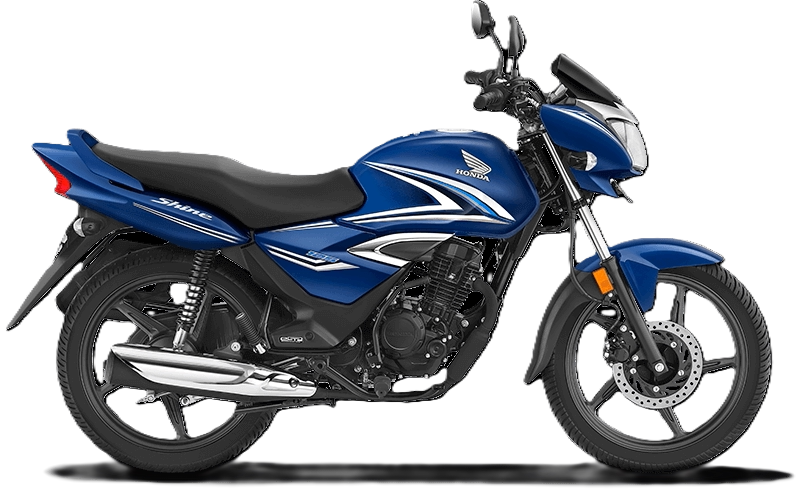
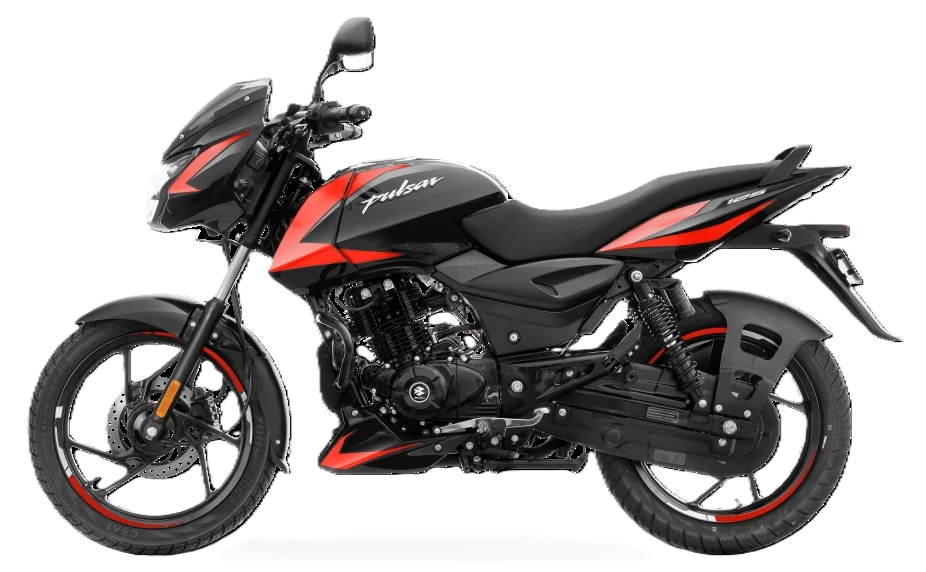
At a Glance
Key differences that define each motorcycle
Honda Shine 125
- 123.94 cc Air-Cooled, 2-valve
- 10.74 PS @ 7500 rpm
- 50–55 km/l (Owner Reported)
- 10.5-litre tank
- 2 variants available
- Benchmark refinement & reliability
Bajaj Pulsar 125
- 124.38 cc Air-Cooled, 2-valve
- 11.8 PS @ 8500 rpm
- 57 km/l (ARAI)
- 15-litre tank
- 3 variants available
- Front disc + CBS on all variants
Full Specification Comparison
Every number that matters — side by side
| Specification | Honda Shine 125 | Bajaj Pulsar 125 |
|---|---|---|
| Engine & Performance | ||
| Displacement | 123.94 cc | 124.38 cc |
| Cooling System | Air-Cooled | Air-Cooled |
| Max Power | 10.74 PS @ 7500 rpm | 11.8 PS @ 8500 rpm |
| Max Torque | 11 Nm @ 6000 rpm | 10.8 Nm @ 6500 rpm |
| Valves per Cylinder | 2 | 2 (Twin Spark) |
| Compression Ratio | 10.0:1 | 10.05 ± 0.3:1 |
| Bore × Stroke | 50.0 × 63.1 mm | 52 × 58.6 mm |
| Emission Standard | BS6 Phase 2 (OBD2) | BS6 Phase 2 |
| Transmission | 5-Speed Manual | 5-Speed Manual |
| Top Speed | 90 km/h | ~100 km/h |
| Riding Modes | No | No |
| Traction Control | No | No |
| Fuel & Range | ||
| Mileage (Claimed) | Not Claimed (50–55 km/l owner reported) | 57 km/l (ARAI) |
| Mileage (Real-world) | ~50–55 km/l | ~45–50 km/l |
| Fuel Tank | 10.5 litres | 15 litres |
| Reserve Capacity | 1.3 litres | 2.5 litres |
| Riding Range | ~500–550 km (estimated) | ~700+ km (ARAI based) |
| Brakes & Wheels | ||
| Braking System | CBS | CBS |
| Front Brake | Drum / Disc – 240 mm (variant dependent) | Disc – 240 mm (all variants) |
| Rear Brake | Drum – 130 mm | Drum – 130 mm |
| Tyre Type | Tubeless | Tubeless |
| Tyre Size (F / R) | 80/100-18 / 80/100-18 | 80/100-17 / 100/90-17 |
| Wheel Size | 18-inch (F & R) | 17-inch (F & R) |
| Wheel Type | Alloy | Alloy |
| Suspension & Chassis | ||
| Front Suspension | Telescopic Fork | Telescopic Fork |
| Rear Suspension | Hydraulic Twin Shock | Twin Gas Shock |
| Rear Preload Adjuster | No | Yes |
| Chassis | Diamond Type Frame | Tubular Frame |
| Dimensions & Weight | ||
| Kerb Weight | 113–114 kg | 144–146 kg |
| Seat Height | 791 mm | 790 mm |
| Ground Clearance | 162 mm | 165 mm |
| Wheelbase | 1285 mm | 1320 mm |
| Overall L × W × H | 2046 × 737 × 1116 mm | 2055 × 755 × 1060 mm |
| Features & Electronics | ||
| Instrument Console | Analogue | Semi-Digital / Digital (variant dependent) |
| Headlight | Halogen | Halogen / LED (variant dependent) |
| DRLs | No | No |
| Tail Light | Bulb | LED |
| Hazard Warning Lights | No | No |
| Gear Indicator | No | Yes |
| Distance to Empty | No | Yes |
| Service Reminder | No | Yes |
| Clock | No | Yes |
| Bluetooth Connectivity | No | Yes (Carbon Fibre variants) |
| Call & SMS Alerts | No | Yes (Bluetooth variants) |
| USB Charging Port | No (USB-C on Disc variant) | Yes (Carbon Fibre variants) |
| Low Fuel Indicator | Yes | Yes |
| Side Stand Engine Cut-off | Yes | Yes |
| Price & Warranty | ||
| Starting Price (ex-showroom) | ₹80,852 | ₹82,420 |
| Top Variant Price | ₹85,211 | ₹92,691 |
| Number of Variants | 2 | 3 |
| Standard Warranty | 3 Years / 42,000 km | 5 Years / 75,000 km |
★ Green highlights indicate the stronger value in each row. Prices are ex-showroom India averages and may vary by city.
Variant-wise Price Comparison
All variants laid out — find the right one for your budget
Shine 125 Variants
Pulsar 125 Variants
Pros & Cons
Honest strengths and weaknesses of each bike
Pros
- Lower starting price — ₹80,852 vs ₹82,420
- Significantly lighter at 113–114 kg vs 144–146 kg
- Benchmark engine smoothness and refinement
- Comfortable suspension tuned for daily use
- Smaller, easier to manoeuvre in traffic
- Proven Honda long-term reliability
- Marginally higher torque (11 Nm vs 10.8 Nm)
- 18-inch wheels for a softer, more cushioned ride
Cons
- No ARAI mileage certification — only owner-reported figures
- Lower peak power (10.74 PS vs 11.8 PS)
- Much smaller 10.5-litre tank — shorter riding range
- Base variant has drum brake only
- Analogue instrument cluster — no digital features
- No gear indicator, distance to empty, or clock
- No Bluetooth or USB charging (Disc variant has USB-C)
- Shorter warranty — 3 years / 42,000 km
- No rear preload adjuster
- Only 2 variants to choose from
Pros
- Higher ARAI-certified mileage — 57 kmpl
- More power — 11.8 PS and higher top speed (~100 km/h)
- Front disc brake standard on all 3 variants
- Massive 15-litre fuel tank for 700+ km range
- Digital console with gear indicator, distance to empty, clock
- Bluetooth, call alerts, and USB on Carbon Fibre variants
- LED tail light and LED headlight on upper variants
- Rear preload-adjustable gas shock absorbers
- Wider rear tyre (100/90-17) for better grip
- Sporty Pulsar styling and muscular presence
- Outstanding 5-year / 75,000 km warranty
Cons
- Much heavier at 144–146 kg vs 113–114 kg
- Higher starting price (₹82,420 vs ₹80,852)
- Top variant significantly pricier at ₹92,691
- Firmer ride — less comfortable on rough roads
- No ABS on any variant
- No DRLs or hazard warning lights
- Neon base variant misses digital features
Key Differences Explained
What really sets these two bikes apart
Engine & Performance
Both bikes run 2-valve, air-cooled, single-cylinder engines in the same displacement class, but they have different characters. The Pulsar 125's 124.38 cc twin-spark engine makes 11.8 PS @ 8500 rpm — nearly 10% more power — with a higher-revving, more energetic delivery suited to spirited riding. The Shine 125's 123.94 cc PGM-FI unit makes 10.74 PS but produces fractionally more torque (11 Nm vs 10.8 Nm), with a smoother, more refined character tuned for effortless city use.
Fuel Efficiency & Range
The Pulsar 125 has a decisive, certified advantage: an ARAI-verified 57 kmpl versus the Shine 125's uncertified owner-reported 50–55 kmpl. More significantly, the Pulsar's 15-litre tank — 43% larger than the Shine's 10.5 litres — delivers an estimated range of 700+ km versus 500–550 km for the Shine. For anyone covering long distances, this is a massive practical difference.
Braking & Safety
The Pulsar 125 holds a clear structural advantage: a 240 mm front disc brake is standard on all three variants, including the base ₹82,420 Neon. The Shine 125 only gets a front disc on its pricier ₹85,211 Disc OBD2 variant; the base drum variant at ₹80,852 gets drum brakes front and rear. Both use CBS. Neither offers ABS — a limitation at this price point for both.
Refinement & Weight
The Honda Shine 125 is in a different league when it comes to smoothness and lightness. At just 113–114 kg, it is 30–32 kg lighter than the Pulsar 125's 144–146 kg — a difference you feel immediately in traffic, when parking, and during low-speed manoeuvres. Honda's PGM-FI engine is also notably smoother and more refined, making everyday riding less tiring. Riders who value ease and finesse over muscle will strongly prefer the Shine.
Warranty & Ownership
The Pulsar 125 dominates here with a 5-year / 75,000 km warranty — significantly better than the Shine 125's 3 years / 42,000 km. That's 67% more years and 79% more kilometre coverage. For a daily commuter clocking 15,000–20,000 km per year, the Pulsar's warranty covers virtually the entire ownership period, providing substantial protection against expensive out-of-warranty repairs.
Price & Value
The Shine 125 starts ₹1,568 cheaper (₹80,852 vs ₹82,420) and tops out at ₹85,211 — ₹7,480 less than the Pulsar's top variant at ₹92,691. However, the Pulsar's base Neon variant at ₹82,420 already includes a front disc brake and a fuller digital console, making it arguably the better-equipped entry point despite the higher price. Buyers who can stretch to the Pulsar's base variant get considerably more hardware for a modest premium.
Expert Verdict
Which one should you actually buy?
Buy the Shine 125 if…
- Engine smoothness and refinement are your top priority
- You want the lightest, easiest-to-handle 125cc bike
- Honda's long-term reliability record matters to you
- Lower starting price is important — ₹80,852
- Your roads are smooth and you cover short daily distances
- You prefer a smaller, nimbler motorcycle in city traffic
- 18-inch wheels for a plusher, more cushioned ride
Buy the Pulsar 125 if…
- A front disc brake on every variant is important to you
- You cover long daily distances and want 700+ km riding range
- Sporty Pulsar styling and muscular road presence appeal to you
- More power (11.8 PS) and higher top speed matter
- ARAI-certified mileage (57 kmpl) and a large 15-litre tank suit your needs
- The outstanding 5-year / 75,000 km warranty is a priority
- Bluetooth and digital features on upper variants excite you
Overall Winner for Most Riders: Bajaj Pulsar 125. A front disc brake standard on all variants, ARAI-certified 57 kmpl mileage, a significantly larger 15-litre fuel tank for a 700+ km range, more power, a richer feature set including digital console, gear indicator and Bluetooth on upper variants, wider tyres for better grip, and an outstanding 5-year / 75,000 km warranty make the Pulsar 125 the better all-round commuter for most Indian buyers. Choose the Honda Shine 125 only if engine refinement, dramatically lighter weight, or Honda's brand reliability are your absolute priorities.
Frequently Asked Questions
Common questions answered by our experts
The Bajaj Pulsar 125 is better for most buyers thanks to its front disc brake standard across all variants, ARAI-certified 57 kmpl mileage, a much larger 15-litre fuel tank, more power (11.8 PS), digital features, and a superior 5-year / 75,000 km warranty. The Honda Shine 125 is better if you prioritise engine refinement and smoothness, a dramatically lighter weight (113–114 kg vs 144–146 kg), a lower starting price, or Honda's long-term reliability reputation.
The Honda Shine 125 starts at ₹80,852 (Drum OBD2) while the Bajaj Pulsar 125 starts at ₹82,420 (Neon Single Seat) — a base difference of ₹1,568. The gap grows considerably at the top: the Shine 125 tops out at ₹85,211, while the Pulsar's Carbon Fibre Split Seat LED reaches ₹92,691 — a difference of ₹7,480. Both are ex-showroom prices and may vary by city.
The Bajaj Pulsar 125 has a certified advantage with an ARAI figure of 57 kmpl. Honda has not officially claimed an ARAI mileage for the Shine 125; owners report around 50–55 kmpl. Beyond efficiency, the Pulsar's 15-litre tank (vs the Shine's 10.5 litres) gives it an estimated 700+ km riding range versus 500–550 km for the Shine — making the Pulsar a far better companion for long daily distances.
The Bajaj Pulsar 125 makes more power at 11.8 PS @ 8500 rpm, compared to the Honda Shine 125's 10.74 PS @ 7500 rpm. The Pulsar also has a higher top speed of around 100 km/h versus 90 km/h for the Shine. The Shine 125 does produce marginally more torque (11 Nm vs 10.8 Nm), making it slightly punchier at lower revs, but the Pulsar's higher power output gives it a more spirited character overall.
Yes, all three Bajaj Pulsar 125 variants — including the base Neon Single Seat at ₹82,420 — come with a 240 mm front disc brake paired with CBS. The Honda Shine 125 only gets a front disc on its Disc OBD2 variant at ₹85,211; its cheaper Drum OBD2 variant at ₹80,852 uses a drum brake setup front and rear. Neither bike offers ABS.
The Bajaj Pulsar 125 has a significantly better warranty at 5 years or 75,000 km, compared to the Honda Shine 125's 3 years or 42,000 km. That is 67% more years and 79% more kilometre coverage. For a daily commuter covering 40–50 km per day (roughly 15,000–18,000 km per year), the Pulsar's warranty covers virtually the entire practical ownership period — a meaningful financial advantage over the Shine.