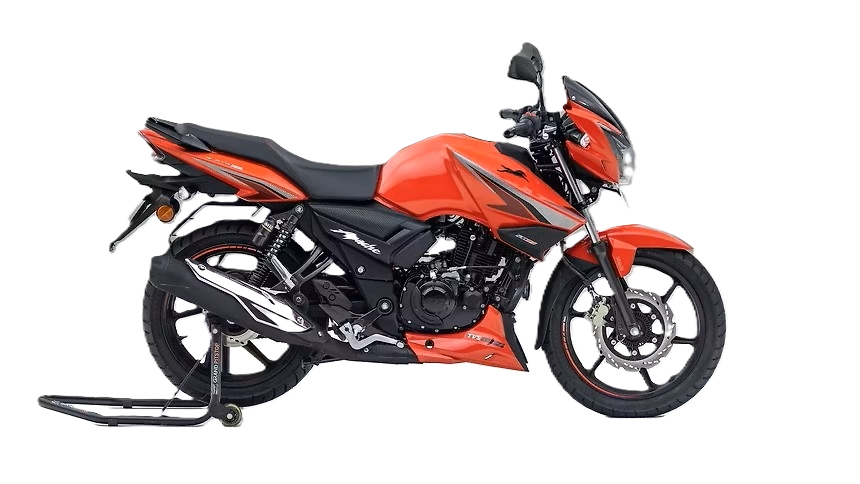
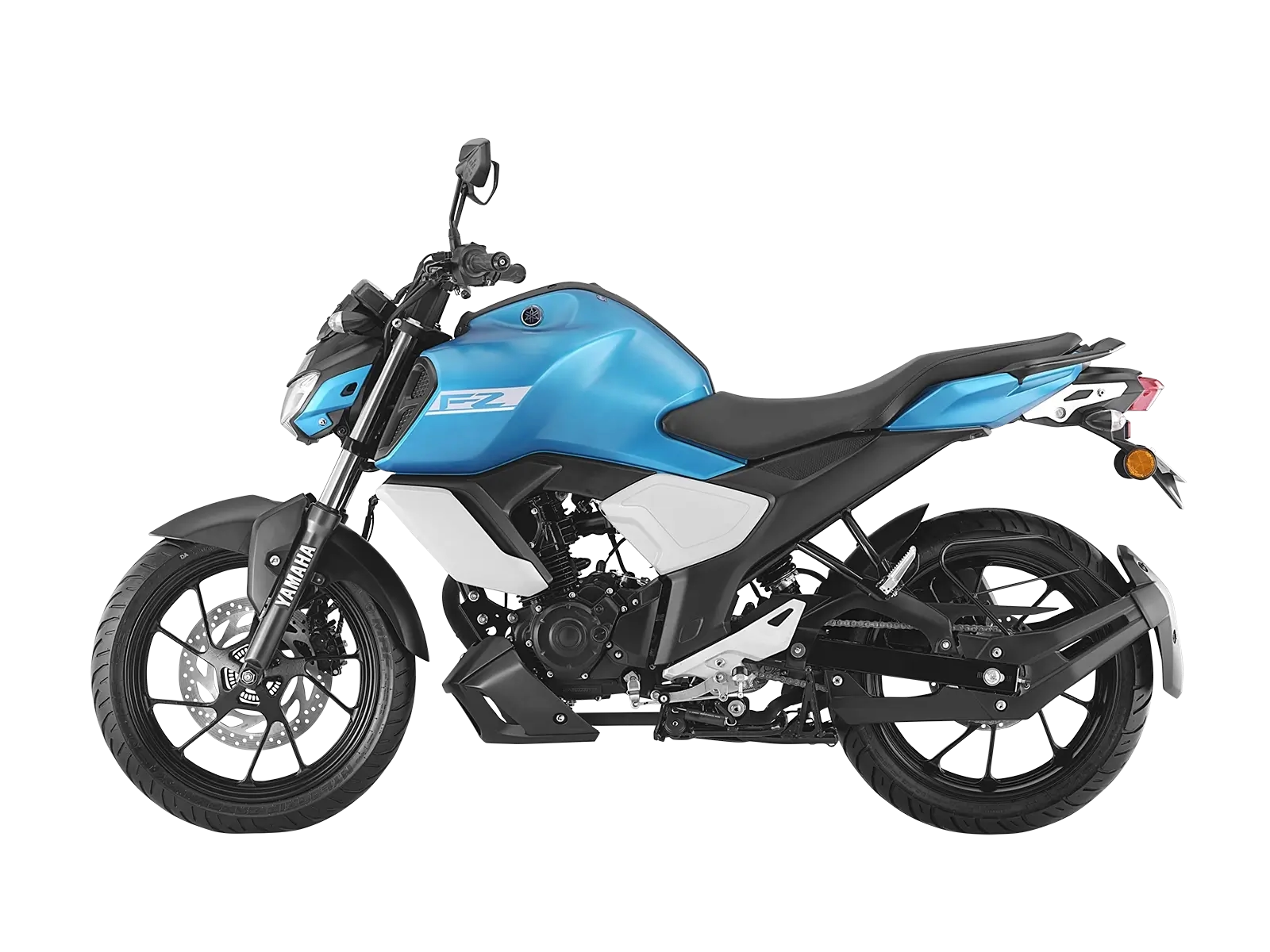
At a Glance
Key differences that define each motorcycle
TVS Apache RTR 160 2V
- 159.7 cc Air-Cooled, 2-valve
- 16.04 PS @ 8750 rpm
- 47 km/l (Claimed)
- 12-litre tank
- 6 variants available
- Ride modes: Sport, Urban, Rain
Yamaha FZ-FI
- 149 cc Air-Cooled, 2-valve
- 12.4 PS @ 7250 rpm
- 49.3 km/l (ARAI)
- 13-litre tank
- 1 variant available
- Bluetooth + Y-Connect standard
Full Specification Comparison
Every number that matters — side by side
| Specification | TVS Apache RTR 160 2V | Yamaha FZ-FI |
|---|---|---|
| Engine & Performance | ||
| Displacement | 159.7 cc | 149 cc |
| Cooling System | Air-Cooled | Air-Cooled |
| Max Power | 16.04 PS @ 8750 rpm | 12.4 PS @ 7250 rpm |
| Max Torque | 13.85 Nm @ 7000 rpm | 13.3 Nm @ 5500 rpm |
| Valves per Cylinder | 2 | 2 |
| Compression Ratio | 9.8:1 | 9.6:1 |
| Bore × Stroke | 62 × 52.9 mm | 57.3 × 57.9 mm |
| Emission Standard | BS6 OBD2 | BS6 Phase 2 |
| Transmission | 5-Speed Manual | 5-Speed Manual |
| Top Speed | 107 km/h | ~115 km/h |
| Riding Modes | Sport, Urban, Rain | No |
| Traction Control | No | No |
| Fuel & Range | ||
| Mileage (Claimed / ARAI) | 47 km/l (Claimed) | 49.3 km/l (ARAI) |
| Real-world Mileage | ~42–45 km/l | 45–50 km/l |
| Fuel Tank | 12 litres | 13 litres |
| Reserve Capacity | 2.5 litres | 2 litres |
| Riding Range | ~564 km | ~640 km |
| Brakes & Wheels | ||
| Braking System | Single / Dual Channel ABS | Single Channel ABS |
| Front Brake | Disc – 270 mm | Disc – 282 mm |
| Rear Brake | Drum 130 mm / Disc 200 mm (variant dependent) | Disc – 220 mm (standard) |
| Tyre Type | Tubeless | Tubeless |
| Tyre Size (F / R) | 90/90-17 / 110/80-17 | 100/80-17 / 140/60-17 |
| Wheel Type | Alloy | Alloy |
| Suspension & Chassis | ||
| Front Suspension | Telescopic Forks | Telescopic Fork |
| Rear Suspension | Mono Tube Inverted Gas Filled Shock | 7-Step Adj. Monocross |
| Chassis | Double Cradle Frame | Diamond Frame |
| Rear Preload Adjuster | Yes | Yes (7-Step) |
| Dimensions & Weight | ||
| Kerb Weight | 139–140 kg | 135 kg |
| Seat Height | 790 mm | 790 mm |
| Ground Clearance | 165 mm | 165 mm |
| Wheelbase | 1300 mm | 1330 mm |
| Overall L × W × H | 2085 × 730 × 1105 mm | 1990 × 780 × 1080 mm |
| Features & Electronics | ||
| Instrument Console | Fully Digital LCD | Fully Digital LCD |
| Headlight | LED | LED |
| DRLs | Yes | Yes |
| Turn Signals | Halogen | Halogen |
| Hazard Warning Lights | No | No |
| Riding Modes | Sport / Urban / Rain | No |
| Bluetooth Connectivity | Yes (Select Variants) | Yes (Standard) |
| Call & SMS Alerts | Yes (Bluetooth variants) | Yes (Standard) |
| USB Charging Port | No | No |
| Distance to Empty | Yes | Yes |
| Gear Indicator | Yes | Yes |
| Tachometer | Digital | Digital |
| Service Reminder | Yes | Yes |
| Navigation | Yes (Select Variants) | Yes (Standard via Y-Connect) |
| Keyless Ignition | No | No |
| Price & Warranty | ||
| Starting Price (ex-showroom) | ₹1,09,036 | ₹1,09,924 |
| Top Variant Price | ₹1,24,661 | ₹1,09,924 (Single Variant) |
| Number of Variants | 6 | 1 |
| Standard Warranty | 5 Years | 2 Years / 30,000 km |
★ Green highlights indicate the stronger value in each row. Prices are ex-showroom India averages and may vary by city.
Variant-wise Price Comparison
All variants laid out — find the right one for your budget
Apache RTR 160 2V Variants
Yamaha FZ-FI Variants
Pros & Cons
Honest strengths and weaknesses of each bike
Pros
- Higher peak power — 16.04 PS, 29% more than FZ-FI
- Ride modes (Sport, Urban, Rain) across all variants
- Lower starting price at ₹1,09,036
- 6 variants — widest choice in this comparison
- Dual-channel ABS available on top variant
- Sporty TVS Racing-inspired design and character
- Stronger 5-year warranty coverage
- Distance to Empty display standard
- Lighter at 139–140 kg vs FZ-FI (wait — FZ is 135 kg)
Cons
- Lower ARAI mileage (47 km/l vs 49.3 km/l)
- Smaller 12-litre tank — shorter range (~564 km)
- Heavier at 139–140 kg vs FZ-FI's 135 kg
- Bluetooth only on select upper variants
- Base variants have rear drum brake
- Smaller 270 mm front disc vs FZ-FI's 282 mm
- Narrower rear tyre (110/80-17 vs 140/60-17)
Pros
- Better ARAI-certified mileage — 49.3 km/l
- Larger 13-litre fuel tank for longer range (~640 km)
- Rear disc brake as standard on all variants
- Wider 140 mm rear tyre for superior stability
- Larger 282 mm front disc brake
- Bluetooth and Y-Connect navigation standard from base
- Lightest in comparison at 135 kg
- Exceptional engine refinement — smooth, vibration-free
- Longer 1330 mm wheelbase for highway stability
- 7-step adjustable rear preload
Cons
- Significantly less power (12.4 PS vs 16.04 PS)
- No riding modes of any kind
- Only 1 variant — no choice or upgrade path
- Weak warranty — only 2 years / 30,000 km
- Single-channel ABS only (no dual-channel option)
- Performance may feel underwhelming for spirited riders
- Higher base price than entry Apache variant
Key Differences Explained
What really sets these two bikes apart
Engine Character
The Apache RTR 160 2V uses a 159.7 cc air-cooled, 2-valve engine producing 16.04 PS — 29% more than the FZ-FI. The engine is tuned for a sporty, energetic character with peak power at 8750 rpm. The Yamaha FZ-FI's 149 cc Blue Core engine produces only 12.4 PS, but is deliberately tuned for smoothness and low-end torque delivery at just 5500 rpm — making it friendlier in city stop-and-go traffic with minimal vibrations.
Fuel Efficiency & Range
The Yamaha FZ-FI leads on certified efficiency with an ARAI-rated 49.3 km/l versus the Apache's claimed 47 km/l. More significantly, the FZ-FI has a larger 13-litre tank compared to the Apache's 12 litres, giving it a theoretical range of ~640 km versus ~564 km — a 76 km advantage. For daily commuters who hate frequent refuelling, the FZ-FI wins convincingly.
Braking & Safety
The FZ-FI has an edge in standard braking hardware: a larger 282 mm front disc, a standard rear disc brake (220 mm), and a wider 140 mm rear tyre that improves overall grip and stability. The Apache's base variants use a rear drum, and its front disc is 270 mm. However, the Apache's top variant offers dual-channel ABS — unavailable on the FZ-FI — for the best overall braking safety in the segment.
Ride Modes & Technology
The Apache RTR 160 2V leads here with Sport, Urban and Rain riding modes across all variants — a segment-first feature that adjusts throttle response and ABS behaviour. The FZ-FI counters with standard Bluetooth connectivity and Yamaha's Y-Connect app offering call/SMS alerts, navigation, and bike diagnostics from the base variant. On the Apache, Bluetooth is only available from the RM Disc Bluetooth variant onwards (4th out of 6).
Warranty & Ownership
The Apache RTR 160 2V holds a decisive advantage with a 5-year warranty compared to the FZ-FI's 2 years / 30,000 km. That is 3 extra years of coverage. For commuters clocking 15,000–20,000 km per year, the Apache remains under warranty for its full early life. The FZ-FI's warranty expires comparatively quickly, potentially exposing owners to out-of-warranty repair costs while the bike is still relatively new.
Price & Value
The two bikes are remarkably close in base price — the Apache starts at ₹1,09,036 and the FZ-FI at ₹1,09,924, a gap of just ₹888. The Apache offers 6 variants from ₹1,09,036 to ₹1,24,661, giving buyers genuine flexibility. The FZ-FI offers no variant choice. For budget-limited buyers who want riding modes and more power, the Apache base is fractionally cheaper. For those who want Bluetooth, rear disc, wider tyre, and refinement in a single hassle-free purchase, the FZ-FI's fixed price is actually quite competitive.
Expert Verdict
Which one should you actually buy?
Buy the Apache RTR 160 2V if…
- You want stronger outright performance (16.04 PS)
- Ride modes — Sport, Urban and Rain — appeal to you
- Spirited city and occasional track-day riding is your style
- A lower entry price (₹1,09,036) is important
- You want 6 variants with an upgrade path to dual-channel ABS
- The 5-year warranty coverage gives you long-term peace of mind
- Apache's race-inspired styling and TVS racing heritage excite you
Buy the Yamaha FZ-FI if…
- Smooth, refined, vibration-free city riding is your priority
- Better ARAI mileage (49.3 km/l) and longer range matter most
- Standard Bluetooth with Y-Connect navigation from day one
- Rear disc brake and larger 282 mm front disc as standard
- Wide 140 mm rear tyre for superior stability at all speeds
- Lightweight handling (135 kg) for easy daily manoeuvrability
- Yamaha's legendary long-term reliability and build quality
Overall Winner for Most Riders: TVS Apache RTR 160 2V. With a marginally lower starting price, significantly more power (16.04 PS vs 12.4 PS), riding modes across all variants, 6 upgrade paths, and a much stronger 5-year warranty, the Apache RTR 160 2V offers more features and performance for effectively the same money. Choose the Yamaha FZ-FI if engine refinement, fuel efficiency, a wider rear tyre, standard Bluetooth, standard rear disc, and Yamaha's exceptional build quality are your top priorities — it remains a compelling, polished alternative that many riders will prefer for its everyday smoothness.
Frequently Asked Questions
Common questions answered by our experts
For performance-focused riders, the TVS Apache RTR 160 2V is better — it delivers 16.04 PS (vs 12.4 PS), riding modes across all variants, a lower base price, 6 variant choices, and a much stronger 5-year warranty. For riders who prioritise refinement, fuel efficiency (49.3 km/l ARAI), a larger tank (13 litres), standard Bluetooth, rear disc, wider rear tyre, and Yamaha's legendary build quality, the FZ-FI is the better daily commuter.
The TVS Apache RTR 160 2V starts at ₹1,09,036 while the Yamaha FZ-FI is priced at ₹1,09,924 ex-showroom — a base difference of just ₹888. The Apache offers 6 variants ranging from ₹1,09,036 to ₹1,24,661, while the FZ-FI is available in a single variant only. Both prices are India averages and may vary by city.
The Yamaha FZ-FI has better ARAI-certified mileage at 49.3 km/l compared to the Apache RTR 160 2V's claimed 47 km/l. The FZ-FI also has a larger 13-litre fuel tank versus the Apache's 12 litres, giving it a longer riding range of approximately 640 km compared to ~564 km for the Apache. Real-world mileage for the FZ-FI is typically 45–50 km/l.
The TVS Apache RTR 160 2V makes significantly more power at 16.04 PS @ 8750 rpm compared to the Yamaha FZ-FI's 12.4 PS @ 7250 rpm — a 29% advantage. The Apache also produces slightly higher peak torque at 13.85 Nm versus 13.3 Nm for the FZ-FI. However, the FZ-FI delivers its torque earlier (5500 rpm) making it smoother in city traffic, while the Apache's power is more energetic and sporty at higher rpm.
Yes, the TVS Apache RTR 160 2V offers three rider-selectable modes — Sport, Urban and Rain — across all its six variants. Sport maximises power delivery, Urban optimises for smooth city performance, and Rain softens throttle response for wet conditions. The Yamaha FZ-FI does not offer any riding modes on its single variant.
The TVS Apache RTR 160 2V offers a considerably better warranty of 5 years compared to the Yamaha FZ-FI's 2 years / 30,000 km. This is a significant ownership advantage — 3 extra years of coverage means the Apache remains under warranty well beyond the period when the FZ-FI's warranty lapses. For high-mileage commuters, this can translate to meaningful savings on potential repair costs.