At a Glance
Key differences that define each motorcycle
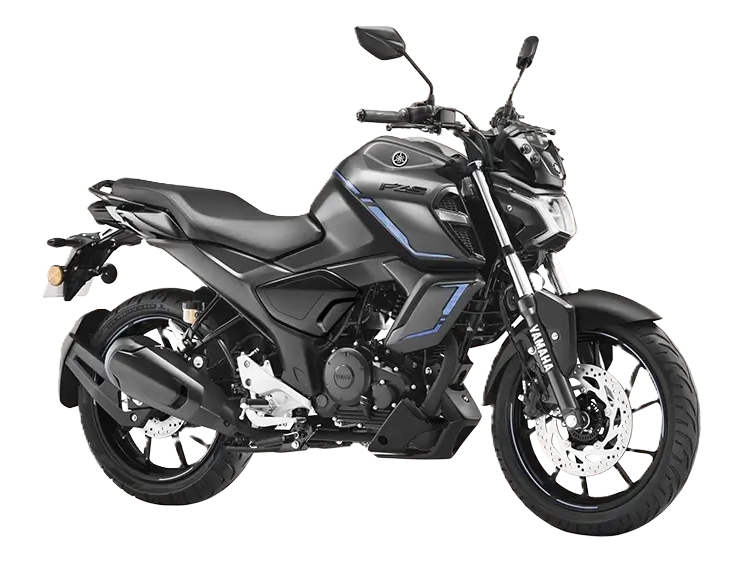
Yamaha FZ-S Fi
- 149 cc Air-Cooled, 2-valve
- 12.4 PS @ 7250 rpm
- 60 km/l (Claimed)
- 13-litre tank
- 1 variant available
- Traction Control + Bluetooth
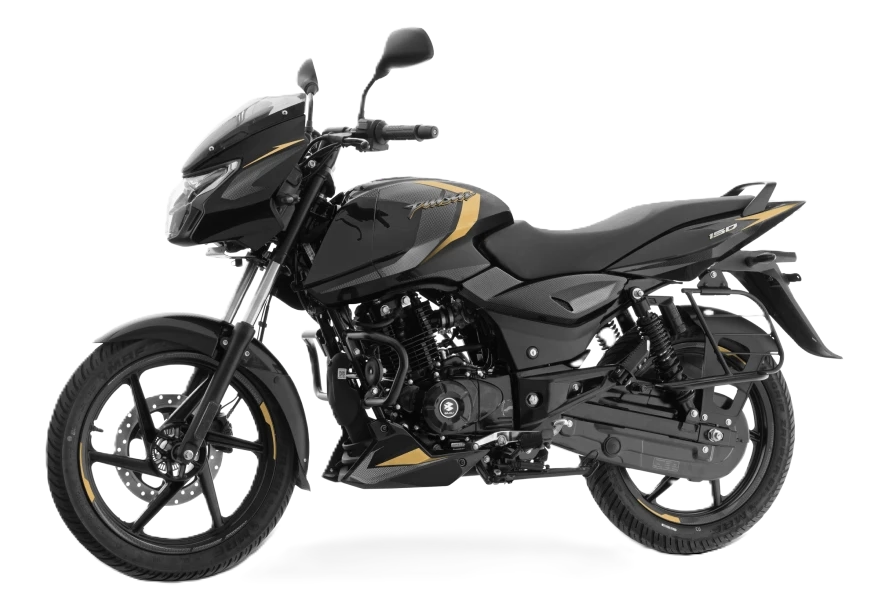
Bajaj Pulsar 150
- 149.5 cc Air-Cooled, 2-valve
- 14 PS @ 8500 rpm
- 47.5 km/l (Claimed)
- 15-litre tank
- 3 variants available
- 5-yr / 75,000 km warranty
Full Specification Comparison
Every number that matters — side by side
| Specification | Yamaha FZ-S Fi | Bajaj Pulsar 150 |
|---|---|---|
| Engine & Performance | ||
| Displacement | 149 cc | 149.5 cc |
| Cooling System | Air-Cooled | Air-Cooled |
| Max Power | 12.4 PS @ 7250 rpm | 14 PS @ 8500 rpm |
| Max Torque | 13.3 Nm @ 5500 rpm | 13.4 Nm @ 6500 rpm |
| Valves per Cylinder | 2 | 2 |
| Bore × Stroke | 57.3 × 57.9 mm | 56 × 60.7 mm |
| Compression Ratio | 9.6 : 1 | 9.5 : 1 |
| Emission Standard | BS6 Phase 2 | BS6 Phase 2 |
| Transmission | 5-Speed Manual | 5-Speed Manual |
| Top Speed | ~115 km/h | ~115 km/h |
| Riding Modes | No | No |
| Traction Control | Yes | No |
| Fuel & Range | ||
| Mileage (Claimed) | 60 km/l | 47.5 km/l |
| Fuel Tank | 13 litres | 15 litres |
| Reserve Capacity | 2 litres | 2.4 litres |
| Riding Range | ~780 km | ~700+ km |
| Brakes & Wheels | ||
| Braking System | Single Channel ABS | Single Channel ABS |
| Front Brake | Disc – 282 mm | Disc – 260 / 280 mm (variant) |
| Rear Brake | Disc – 220 mm | Drum / Disc (variant dependent) |
| Tyre Type | Tubeless | Tubeless |
| Tyre Size (F / R) | 100/80-17 / 140/60-17 | 80/100-17 / 100/90-17 |
| Wheel Type | Alloy | Alloy |
| Suspension & Chassis | ||
| Front Suspension | Telescopic Fork | Telescopic |
| Rear Suspension | 7-Step Adjustable Monocross | Twin Gas Shock |
| Rear Preload Adjuster | Yes | Yes |
| Chassis | Diamond Frame | Perimeter Frame |
| Dimensions & Weight | ||
| Kerb Weight | 137 kg | 148–150 kg |
| Seat Height | 790 mm | 785 mm |
| Ground Clearance | 165 mm | 165 mm |
| Wheelbase | 1330 mm | 1320–1345 mm |
| Overall L × W × H | 1990 × 780 × 1080 mm | 2055 × 755 × 1060 mm |
| Features & Electronics | ||
| Instrument Console | Fully Digital LCD | Fully Digital LCD |
| Headlight | LED | LED |
| DRLs | Yes | No |
| Turn Signals | LED | LED |
| Hazard Warning Lights | Yes | No |
| Traction Control | Yes | No |
| Bluetooth Connectivity | Yes (Y-Connect) | Yes |
| Call & SMS Alerts | Yes | Yes |
| USB Charging Port | No | Yes |
| Distance to Empty | Yes | Yes |
| Gear Indicator | Yes | Yes |
| Tachometer | Digital | No |
| Service Reminder | Yes | Yes |
| Keyless Ignition | No | No |
| Price & Warranty | ||
| Starting Price (ex-showroom) | ₹1,25,000 | ₹1,10,120 |
| Top Variant Price | ₹1,25,000 | ₹1,16,916 |
| Number of Variants | 1 | 3 |
| Standard Warranty | 2 Years / 30,000 km | 5 Years / 75,000 km |
★ Green highlights indicate the stronger value in each row. Prices are ex-showroom India averages and may vary by city.
Variant-wise Price Comparison
All variants laid out — find the right one for your budget
FZ-S Fi Variants
Pulsar 150 Variants
Pros & Cons
Honest strengths and weaknesses of each bike
Pros
- Traction control for improved safety on wet roads
- Bluetooth connectivity via Yamaha Y-Connect app
- DRLs and hazard warning lights standard
- Rear disc brake (220 mm) for better braking balance
- Larger 282 mm front disc — bigger than Pulsar's 260 mm base
- Fully digital LCD with tachometer
- 7-step adjustable rear monoshock
- Lighter at 137 kg vs 148–150 kg
- Claimed mileage of 60 km/l
Cons
- Lower peak power (12.4 PS vs 14 PS)
- More expensive at ₹1,25,000 — up to ₹14,880 premium over base Pulsar
- Smaller 13-litre tank vs Pulsar's 15 litres
- Significantly weaker warranty: 2 years / 30,000 km only
- No USB charging port
- Only one variant — no choice of configuration
- Mileage is claimed, not ARAI certified
Pros
- Higher peak power – 14 PS @ 8500 rpm
- Larger 15-litre fuel tank for extended range (~700+ km)
- Outstanding 5-year / 75,000 km warranty
- 3 variants — including Twin Disc UG with rear disc brake
- Lower starting price at ₹1,10,120 (saves up to ₹14,880)
- USB charging port standard
- Bluetooth and call/SMS alerts on all variants
- Perimeter frame for improved high-speed stability
- LED turn signals standard
Cons
- No traction control on any variant
- No DRLs or hazard warning lights
- No tachometer on digital console
- Heavier at 148–150 kg
- Rear drum on base two variants
- No adjustable monoshock — uses twin gas shocks
- Lower claimed mileage (47.5 km/l)
Key Differences Explained
What really sets these two bikes apart
Engine & Performance
The Pulsar 150 holds a meaningful engine advantage with its 149.5 cc unit producing 14 PS and 13.4 Nm against the FZ-S Fi's 149 cc, 12.4 PS and 13.3 Nm. That 1.6 PS gap translates to noticeably quicker acceleration, especially for overtaking on highways. The FZ-S Fi compensates with traction control that helps manage power delivery on slippery surfaces — a safety feature entirely absent on the Pulsar.
Fuel Efficiency & Range
The FZ-S Fi claims 60 km/l against the Pulsar's 47.5 km/l, but neither is ARAI certified — both are manufacturer claims. The Pulsar's larger 15-litre tank (vs 13 litres) delivers a longer practical riding range of ~700+ km even at lower efficiency. The FZ-S Fi's 780 km estimated range edges ahead only if its 60 km/l figure holds in real-world riding, which is optimistic.
Braking & Safety
The FZ-S Fi leads in braking hardware: a 282 mm front disc and 220 mm rear disc are standard, versus the Pulsar's 260 mm front disc and rear drum on its two base variants. The FZ-S Fi also adds traction control, which is the more meaningful active safety differentiator. The Pulsar's Twin Disc UG (₹1,16,916) partially closes the gap with a rear disc, but still has no traction control.
Technology & Features
Both bikes offer Bluetooth, digital consoles, gear indicators, service reminders and distance-to-empty displays. The FZ-S Fi goes further with traction control, DRLs, hazard warning lights, a tachometer and a 7-step adjustable rear monoshock. The Pulsar counters with a USB charging port (absent on the FZ-S Fi), LED turn signals and Bajaj's more established Bluetooth ecosystem with call and SMS alerts.
Warranty & Ownership
The Pulsar 150 wins this category decisively with an industry-leading 5-year / 75,000 km warranty against the FZ-S Fi's 2-year / 30,000 km coverage. That is 2.5 times longer duration and 2.5 times more kilometre coverage — a transformative difference for daily commuters who clock 15,000–20,000 km annually and want to avoid expensive out-of-warranty repair costs.
Price & Value
The Pulsar 150 starts at ₹1,10,120 — ₹14,880 less than the FZ-S Fi's ₹1,25,000. Even the fully loaded Twin Disc UG at ₹1,16,916 is ₹8,084 cheaper than the FZ-S Fi. The Pulsar also includes a USB charging port, more power, a bigger tank and a vastly superior warranty at every price point. The FZ-S Fi's premium is justified only if traction control, DRLs and rear disc brakes are your non-negotiables.
Expert Verdict
Which one should you actually buy?
Buy the FZ-S Fi if…
- Traction control for safer riding is a priority
- Rear disc brakes and a larger 282 mm front disc matter
- DRLs, LED turn signals and hazard lights are important
- Bluetooth via Yamaha Y-Connect and call alerts suit your needs
- You value a fully digital console with tachometer display
- A sportier, lighter streetfighter character appeals to you
- Adjustable rear suspension for ride tuning is valuable
Buy the Pulsar 150 if…
- More power (14 PS) for overtaking and highway riding matters
- A larger 15-litre tank for fewer fuel stops is important
- Budget is a concern — starts ₹14,880 cheaper
- The outstanding 5-year / 75,000 km warranty is a priority
- USB charging standard from base is needed
- You want variant choices including Twin Disc UG
- Long-term ownership cost and reliability are key criteria
Overall Winner for Most Riders: Bajaj Pulsar 150. More power, a significantly larger fuel tank, a lower starting price at every variant level, USB charging as standard and an industry-leading 5-year / 75,000 km warranty make the Pulsar 150 the better-value and more practical choice for the majority of Indian commuters. Choose the Yamaha FZ-S Fi only if traction control, rear disc brakes, DRLs and a sportier streetfighter character are your non-negotiable priorities — it delivers a genuinely more technology-forward package, but at a ₹14,880 premium with a warranty that is 2.5 times shorter.
Frequently Asked Questions
Common questions answered by our experts
The Bajaj Pulsar 150 is better for most riders due to more power (14 PS), a larger 15-litre fuel tank, lower price across all three variants, USB charging and an outstanding 5-year / 75,000 km warranty. The Yamaha FZ-S Fi is better if traction control, rear disc brakes, DRLs and Yamaha's sportier streetfighter character are your top priorities — it costs ₹14,880 more but delivers a notably more technology-rich experience.
The Bajaj Pulsar 150 starts at ₹1,10,120 (Single Disc) while the Yamaha FZ-S Fi is priced at ₹1,25,000 — a base difference of ₹14,880. The Pulsar's top Twin Disc UG variant at ₹1,16,916 is still ₹8,084 cheaper than the FZ-S Fi. All prices are ex-showroom India averages and may vary by city.
The Yamaha FZ-S Fi claims 60 km/l while the Bajaj Pulsar 150 claims 47.5 km/l — however, neither figure is ARAI certified. In real-world riding, both bikes typically deliver somewhat less than their claimed figures. Despite the FZ-S Fi's higher mileage claim, the Pulsar 150's larger 15-litre tank (vs 13 litres) still gives it a competitive riding range of ~700+ km.
The Bajaj Pulsar 150 makes more power at 14 PS @ 8500 rpm and slightly more torque at 13.4 Nm @ 6500 rpm compared to the Yamaha FZ-S Fi's 12.4 PS @ 7250 rpm and 13.3 Nm @ 5500 rpm. The 1.6 PS advantage makes the Pulsar noticeably stronger for overtaking and highway riding.
Yes, the Yamaha FZ-S Fi comes with traction control as standard. The Bajaj Pulsar 150 does not offer traction control on any of its three variants. The FZ-S Fi also adds DRLs, hazard warning lights and a rear disc brake that the Pulsar's base and mid variants do not have — though the Pulsar Twin Disc UG does include a rear disc.
The Bajaj Pulsar 150 offers an outstanding 5-year / 75,000 km warranty while the Yamaha FZ-S Fi provides just 2 years / 30,000 km. This means the Pulsar's warranty covers 2.5 times the duration and 2.5 times the mileage. For high-mileage daily commuters, the Pulsar's extended coverage can save significantly on out-of-warranty repair costs.